
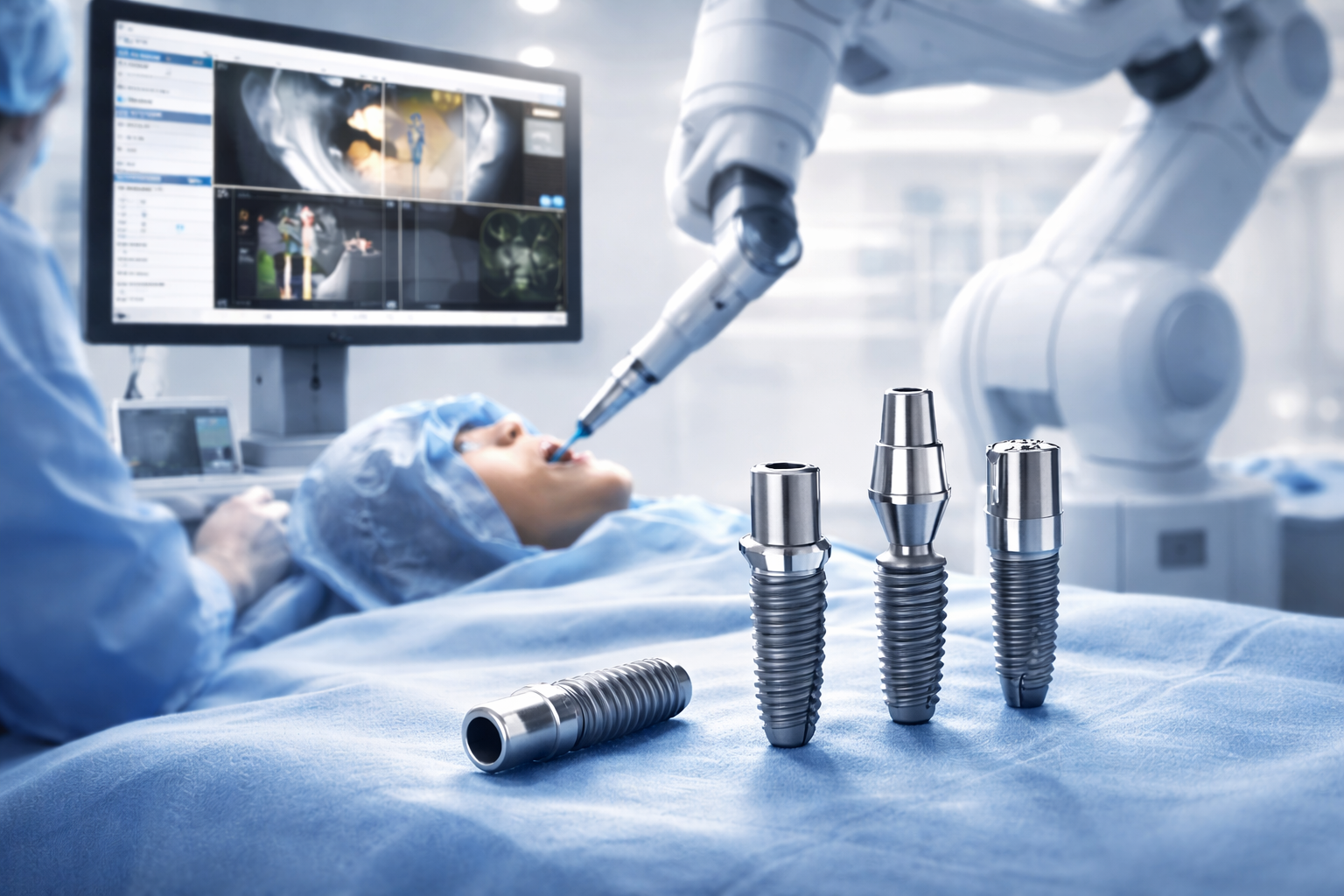
Digital technologies are transforming modern implant dentistry. Dynamic and robotic computer-assisted implant surgery (d-CAIS and r-CAIS) are leading the way, offering a new standard of precision, safety and workflow efficiency.
A recent Australian Dental Journal review by Yulan Wang and colleagues outlines a forward-looking digital workflow that’s now within reach for general dentists. The review demonstrates how real-time navigation systems and robotic arms can improve implant placement accuracy, reduce patient trauma, and enhance both practitioner experience and outcomes — even in complex procedures.
What Is Dynamic Navigation?
Dynamic navigation (d-CAIS) is a real-time, computer-assisted guidance system that acts like GPS for your implant handpiece. Unlike static guides, which require time-consuming lab fabrication, d-CAIS uses 3D imaging and optical tracking to guide the clinician through surgery on the screen or via AR/MR headsets.
This system allows for:
-
Greater flexibility during the procedure
-
High positional accuracy (mean deviation often <1.5 mm)
-
Reduced patient trauma, especially in flapless procedures
-
Streamlined workflow, enabling same-day planning and placement
According to the review, dynamic systems are ideal for cases involving:
-
Immediate implant placement
-
Full-arch reconstructions
-
Transcrestal sinus lift elevation
-
Complex posterior placements with limited visibility
Enter the Robots: r-CAIS in Focus
Robotic guidance (r-CAIS) takes digital precision a step further. A robotic arm carries out the osteotomy and implant placement as per the virtual plan, with minimal human intervention. This reduces the cognitive load on clinicians and improves consistency.
Advantages of r-CAIS:
-
Unmatched precision (mean deviation as low as 0.54 mm)
-
Reduced human error from fatigue or poor visibility
-
Easier learning curve for newer clinicians
-
Excellent safety profile, with few reported adverse events
However, robotic systems also have limitations — particularly in terms of cost, setup time, and challenges in navigating tight posterior spaces due to current hardware limitations.
When Should You Use Which?
-
Choose d-CAIS for versatility, agility, and practices seeking to gradually adopt digital workflows.
-
Choose r-CAIS when surgical consistency, precision and reduced operator fatigue are key — and when budget and space allow for it.
The review also notes that patient acceptance of robot-assisted surgery is positive, with comparable or better outcomes in comfort and post-op anxiety than traditional techniques.
Why BioConcept Implants Are an Ideal Match for Guided Surgery
Whether you’re using freehand, static, or dynamic techniques, BioConcept Australia’s bone-level implants are designed for precision placement.
Our implant systems are:
- 100% compatible with Straumann, making integration seamless for practices already using those workflows.
- Engineered for accuracy, with precision-milled components and a full range of surgical and restorative options.
- Trusted globally, with use in over 60 countries and supported by a local Australian team.
For guided surgery workflows like those described in this study, BioConcept’s Bone Level Tapered (BLT) implants offer the geometry and stability required for immediate placement and optimal primary stability — making them a reliable choice for clinicians adopting new technologies.
Want to learn more about how BioConcept implants can support your guided surgery workflow?
Visit bioconceptaustralia.com or get in touch with our team for product support and clinical guidance.
“Dynamic and Robotic Computer‐Assisted Implant Surgery: A Possible Workflow for the General Dentist” was published in the Australian Dental Journal (2025) by Dr Tony Wang and colleagues.
